
The Psychology of Potential
Understanding What You're Capable of Becoming
What a man can be, he must be. This need we call self-actualization." (Abraham Maslow)
Introduction: From Thinking to Understanding
Last month, we launched CloseTHEGAP2026 with Targeted Thinking: The Mental Discipline That Closes The Gap. We established that closing the gap between who you are and who you’re capable of becoming requires deliberate mental discipline – the ability to align your thoughts with your destiny.
But here’s the question that naturally follows:
What exactly IS your potential? How do you know what you're truly capable of becoming?
You can’t target what you don’t understand. You can’t close a gap you haven’t measured. You can’t actualize potential you haven’t identified.
This is where most people get stuck. They feel the fire within, that entelechy calling them to become, but they don’t understand the psychological framework of their own potential. They’re driving toward a destination they can’t clearly see.
Welcome to Month 2 of CloseTHEGAP2026: The Psychology of Potential.
In this article, we’re going deeper than positive thinking or motivation. We’re exploring the actual science and psychology behind human potential:
- What is potential, really? (Beyond vague definitions)
- How do psychologists measure and understand it?
- What prevents most people from accessing their full potential?
- How do you identify YOUR specific potential vs. someone else's?
- What are the psychological stages of actualizing potential?
- How does understanding your potential accelerate your growth?
This isn’t just theory. Understanding the psychology of your potential is what transforms vague dreams into specific targets. It’s what converts the general feeling of “I could be more” into the precise vision of “Here’s exactly what I’m capable of becoming.”
Remember: You cannot actualize what you do not understand.
Let’s understand your potential.

What Is Potential? A Scientific Definition
The word “potential” gets thrown around casually in self-help culture: “You have so much potential!” “Don’t waste your potential!” “Unlock your potential!” But what does it actually mean?
The Physics Metaphor
In physics, potential energy is stored energy that has the capacity to do work but hasn’t yet been released. A boulder sitting at the top of a hill has tremendous potential energy. It’s not moving, it’s not doing anything visible, but the capacity for impact is enormous.
The moment something converts that potential into kinetic energy – the boulder rolls down the hill – you see the impact.
This is the perfect metaphor for human potential.
The Psychological Definition
In psychology, potential refers to: The latent qualities, abilities, and capabilities that exist within an individual but have not yet been fully developed, expressed, or actualized.
Think of it this way:
- Potential = What you COULD be - (given the right conditions, development, and choices)
- Actuality = What you ARE - (your current state of development and expression)
- The Gap = The distance between these two states
The Biological Reality
From a biological perspective, you were born with specific genetic potentials:
- Physical capabilities (strength, coordination, endurance)
- Cognitive capabilities (intelligence, processing speed, memory)
- Emotional capabilities (empathy, resilience, emotional regulation)
- Creative capabilities (imagination, innovation, artistic expression)
But here’s what’s crucial: Genetics load the gun, but environment and choice pull the trigger.
Research in epigenetics shows that gene expression is influenced by:
- Your thoughts and beliefs
- Your behaviors and habits
- Your environment and relationships
- Your experiences and learning
- Your choices and decisions
The Aristotelian Framework
Remember entelechy? Aristotle’s concept that we discussed in our foundational article?
Aristotle distinguished between two states:
- Potentia: (potentiality) - what something could be
- Actus: (actuality) - what something currently is
An acorn has the potentia to become an oak tree. It’s not an oak tree yet, but the complete blueprint exists within it. Entelechy is the inner force that drives the acorn to actualize that potential.
You are the acorn. Your fullest self is the oak tree. Entelechy is the fire within calling you to grow. But you must understand the blueprint.
The Maslow Framework: The Hierarchy of Human Potential
No discussion of human potential is complete without Abraham Maslow, the psychologist who spent his career studying what humans are capable of becoming.
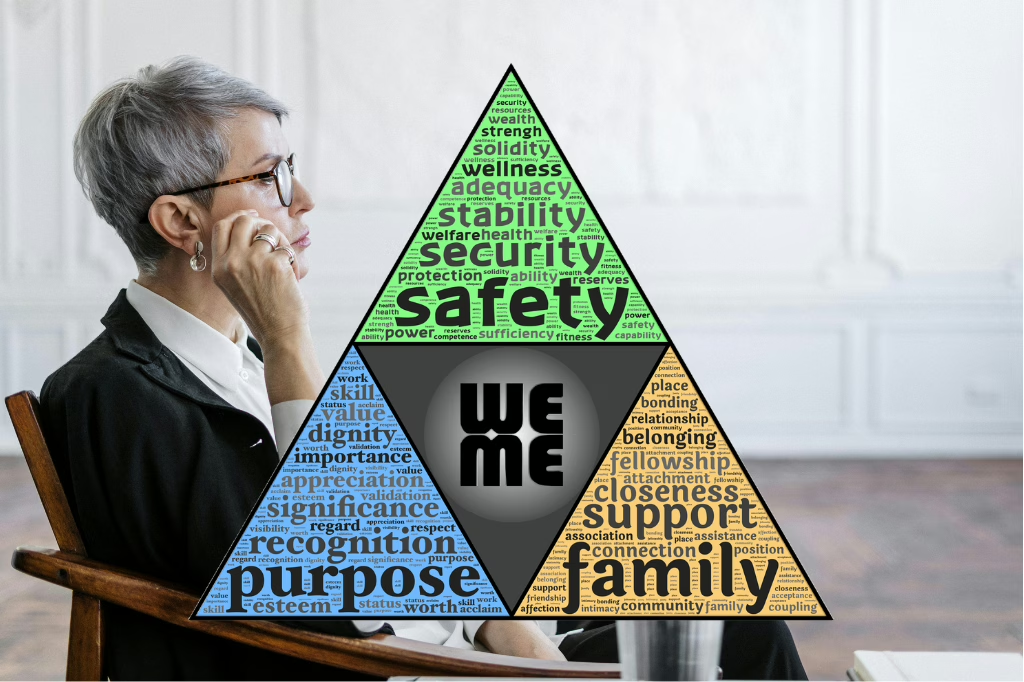
Maslow's Hierarchy of Needs
You’ve probably seen the pyramid:
- Physiological Needs: food, water, shelter, sleep.
- Safety Needs: security, stability, freedom from fear.
- Love & Belonging: relationships, connection, community.
- Esteem Needs: respect, recognition, achievement, confidence.
- Self-Actualization: becoming your fullest self.
What Is Self-Actualization?
Maslow defined self-actualization as:
"The full use and exploitation of talents, capacities, and potentialities. Self-actualizing people are not 'perfect,' but they are fulfilling themselves and doing the best they are capable of doing."
He studied exceptional individuals such Einstein, Eleanor Roosevelt, Abraham Lincoln, and Thomas Jefferson, and identified common characteristics of self-actualized people:
Characteristics of Self-Actualized Individuals:
- Realistic perception of reality: They see things as they are, not through distortions of fear or desire
- Acceptance of self, others, and nature: They embrace reality, including imperfections
- Spontaneity and simplicity: They're authentic, not trying to be someone they're not
- Problem-centered rather than self-centered: They focus on missions bigger than themselves
- Need for privacy and independence: They're comfortable with solitude and thinking independently
- Autonomous and resistant to enculturation: They think for themselves, resist conformity
- Fresh appreciation of life: They maintain wonder and gratitude, avoiding jadedness
- Peak experiences: Moments of profound meaning, connection, and transcendence
- Deep interpersonal relationships: Fewer but deeper connections
- Democratic character structure: They respect all people regardless of status
- Strong ethical standards: Clear values that guide behavior
- Philosophical sense of humor: They can laugh at human nature, not cruelty
- Creativity: Not just artistic; creative in living, problem-solving, thinking
- Resistance to conformity: They follow their own path
Key insight: Self-actualization isn’t about being perfect. It’s about becoming the fullest expression of who you uniquely are.
The Critical Question Maslow Asked
Maslow observed that most people never reach self-actualization. He estimated that less than 1% of the population actualizes their full potential.
Why?
Because most people spend their entire lives stuck in deficiency needs (levels 1-4), never graduating to growth needs (level 5).
They’re so busy trying to survive, feel safe, belong, and prove themselves that they never ask:
"What am I truly capable of becoming?"
This is the question we’re answering in CloseTHEGAP2026.

The Gap: Potential vs. Reality
Let’s get specific about YOUR gap. Right now, there’s a distance between:
Your Current Reality:
- The business you're running vs. the empire you envision
- The income you're generating vs. the value you're capable of creating
- The impact you're having vs. the legacy you're meant to leave
- The person you are vs. the person you're becoming
Your Potential Reality:
- What you COULD build with full actualization
- What you COULD earn if fully leveraging your capabilities
- What you COULD create if operating at your highest level
- Who you COULD become if you removed all self-imposed limitations
The Three Types of Gaps
1. The Knowledge Gap: You don’t know what you don’t know. There are capabilities within you that you’re completely unaware of because you’ve never been in situations that revealed them.
Example: You might have exceptional leadership potential, but if you’ve never led anything, you don’t know it exists.
2. The Development Gap: You know certain potentials exist, but they’re underdeveloped. Like a muscle you’ve never trained, it’s there, but weak.
Example: You know you’re creative, but you’ve never disciplined that creativity into a systematic practice.
3. The Expression Gap: You have developed capabilities, but you’re not expressing them. You’re playing small, hiding, or operating below your capacity.
Example: You’re a skilled strategist, but you’re stuck in tactical execution work, never using your strategic thinking.
Most people have all three gaps simultaneously.
- Identify what capabilities exist within you (closing the knowledge gap)
- Develop those capabilities systematically (closing the development gap)
- Express those capabilities fully (closing the expression gap)

The Psychological Barriers to Actualizing Potential
If potential exists within you, why isn’t it automatically expressed? Because psychology is complicated. Your mind has defense mechanisms, limiting beliefs, and unconscious patterns that actively prevent actualization.
Barrier 1: The Impostor Syndrome
- What it is: The persistent belief that you're not as competent as others perceive you to be, and that you'll eventually be "found out" as a fraud.
- How it blocks potential: You downplay your capabilities, avoid opportunities that would stretch you, and dismiss evidence of your competence.
- Psychological root: Usually stems from early experiences where achievement was tied to approval, creating anxiety that achievement will lead to exposure.
- The antidote: Understand that impostor syndrome is actually a sign of growth. You feel like an impostor because you're stepping into a bigger version of yourself. The discomfort is evidence you're expanding, not proof you don't belong.
Barrier 2: The Fixed Mindset
What it is: Carol Dweck’s research identified two mindsets:
- What it is: Carol Dweck's research identified two mindsets:
- Fixed Mindset: Believes abilities are static ("I'm just not good at that")
- Growth Mindset: Believes abilities can be developed ("I can learn that")
- How it blocks potential: If you believe your capabilities are fixed, you avoid challenges that might reveal limitations, you give up easily, and you see effort as fruitless.
- Psychological root: Often developed in childhood when praise focused on traits ("You're so smart!") rather than effort ("You worked really hard!").
- The antidote: Reframe failure as data, not identity. "I failed" vs. "I am a failure." The first is a result; the second is a conclusion about your potential. Only one is true.
Barrier 3: The Comfort Zone Trap
- What it is: The psychological preference for familiar discomfort over unfamiliar growth.
- How it blocks potential: You stay in situations, relationships, and roles that feel "safe" even when they're limiting, because the fear of the unknown is greater than the pain of the known.
- Psychological root: Your brain is wired for survival, not growth. The amygdala (fear center) is more powerful than the prefrontal cortex (growth center). Staying where you are feels safer than risking change.
- The antidote: Recognize that your comfort zone is expanding or contracting—it's never static. If you're not deliberately expanding it, it's contracting. Actualization requires deliberate discomfort.
Barrier 4: The Comparison Trap
- What it is: Measuring your potential and progress against others rather than against your own capacity.
- How it blocks potential: You either feel superior (and stop growing) or inferior (and stop trying). Either way, you're not focused on YOUR potential.
- Psychological root: Social comparison is a normal human behavior (we're tribal creatures), but social media has intensified it to pathological levels.
- The antidote: The only comparison that matters is you vs. you. Are you closer to your potential today than you were yesterday? That's the only metric that counts.
Barrier 5: The Scarcity Mindset
- What it is: The belief that resources (time, money, opportunities, success) are limited, and if someone else succeeds, there's less available for you.
- How it blocks potential: You hoard rather than share, compete rather than collaborate, and see others' success as threatening rather than inspiring.
- Psychological root: Often comes from early experiences of lack or environments where resources were genuinely scarce.
- The antidote: Abundance thinking. Your potential isn't diminished by someone else actualizing theirs. In fact, being around actualized people often accelerates your own growth.
Barrier 6: The Identity Lock
- What it is: You've created a self-concept based on your past, and you unconsciously resist anything that contradicts that identity.
- How it blocks potential: If you identify as "someone who struggles with money," you'll unconsciously sabotage financial success. If you identify as "not a leader," you'll avoid leadership opportunities.
- Psychological root: Identity provides psychological stability. Changing your identity creates temporary instability, which feels dangerous even when it's growth.
- The antidote: Identity is not fixed; it's chosen and updated. Who you were is not who you must remain. The question isn't "Who am I?" but "Who am I becoming?"
This is where Targeted Thinking from last month becomes critical. These psychological barriers are maintained by thought patterns. Change your thinking, and you dismantle the barriers.

The Stages of Potential Actualization
Stage 1: Unconscious Incompetence (Ignorance)
Characteristics:
- You don't know what you don't know
- You're unaware of your potential in specific areas
- You might be operating on autopilot, not questioning your capacity
Example: You’ve never considered that you might be an excellent public speaker because you’ve avoided it your whole life.
What’s needed: Exposure to new experiences, environments, and challenges that reveal hidden capabilities.
Psychological work: Curiosity. Ask yourself: “What capabilities might I have that I’ve never explored?”
Stage 2: Conscious Incompetence (Awareness)
Characteristics:
- You become aware of a potential capability but recognize you're currently incompetent
- This stage is uncomfortable. You see the gap clearly
- Many people retreat back to Stage 1 to avoid this discomfort
Example: You attend a conference, hear an incredible speaker, and realize: “I could do that, but I’m not good at it yet.”
What’s needed: Commitment to development despite discomfort. Accept that competence requires incompetence first.
Psychological work: Courage. Embrace being a beginner. Your ego will resist. Push through.
Stage 3: Conscious Competence (Development)
Characteristics:
- You're developing the capability, but it requires deliberate effort and concentration
- You can perform, but it's not natural yet
- Mistakes still happen; it's mentally exhausting
Example: You’re giving presentations, but you’re nervous, over-preparing, and hyper-aware of every word.
What’s needed: Practice. Lots of it. Repetition builds neural pathways that make the behavior more automatic.
Psychological work: Discipline. This is where Targeted Thinking and deliberate practice separate those who actualize from those who quit.
Stage 4: Unconscious Competence (Mastery)
Characteristics:
- The capability has become automatic, natural, effortless
- You don't have to think about it consciously. It flows
- You're operating at a high level with minimal cognitive load
Example: You walk on stage and command the room naturally. Speaking publicly feels as comfortable as having a conversation.
What’s needed: Continued refinement and expansion into new applications of the mastery.
Psychological work: Contribution. At this stage, you’re ready to teach others, multiply your impact, and expand into new areas of potential.
Stage 5: Reflective Competence (Wisdom)
Characteristics:
- You're not just competent; you understand WHY you're competent
- You can deconstruct your process and teach it to others
- You can innovate and create new approaches
Example: You walk on stage and command the room naturally. Speaking publicly feels as comfortable as having a conversation.
What’s needed: Continued refinement and expansion into new applications of the mastery.
Psychological work: Contribution. At this stage, you’re ready to teach others, multiply your impact, and expand into new areas of potential.
Example: You’re not just a great speaker; you understand the psychology of persuasion, audience engagement, and storytelling. You can teach others the frameworks.
What’s needed: Synthesis of experience into teachable principles. Legacy building.
Psychological work: Wisdom. Extract lessons not just for yourself but for those following behind you.
Here's the key insight: You're at different stages for different potentials.

Your Unique Potential: Not Generic, But Specific
Here’s where most “potential” conversations fail: They’re too generic.
“You have unlimited potential!” “You can be anything!”
That’s not true. And pretending it is sets you up for frustration.
You don't have unlimited potential. You have SPECIFIC potential.
The Four Dimensions of Specific Potential
1. Innate Aptitudes (What You're Naturally Good At)
- Verbal reasoning and communication
- Spatial reasoning and design
- Mathematical and logical thinking
- Interpersonal sensitivity and empathy
- Physical coordination and kinesthetic intelligence
- Pattern recognition and strategic thinking
- Musical or rhythmic abilities
- Artistic and creative expression
How to identify yours:
- What do people consistently compliment you on?
- What comes easily to you that others struggle with?
- What activities put you in "flow" state where time disappears?
- What did you naturally gravitate toward as a child before the world told you what to do?
2. Acquired Skills (What You've Learned)
These are capabilities you’ve developed through education, training, and experience. They weren’t necessarily natural, but you invested time in building them.
Examples:
- Technical skills (coding, design, accounting, etc.)
- Industry knowledge (healthcare, finance, technology, etc.)
- Soft skills (negotiation, project management, leadership)
- Specialized expertise (legal, medical, engineering, etc.)
How to inventory yours:
- What have you been trained in formally?
- What have you learned through work experience?
- What certifications, degrees, or credentials do you hold?
- What could you teach someone else right now?
3. Passion-Driven Interests (What You Care About)
These are areas where you have emotional energy and intrinsic motivation. You think about them voluntarily. You’d do them even without external reward.
Examples:
- Causes you care about (education, poverty, environment, justice, etc.)
- Problems you want to solve
- Industries or topics that fascinate you
- Activities that energize rather than drain you
How to identify yours:
- What do you read about voluntarily?
- What problems make you angry or sad when you see them?
- What would you work on if money wasn't a factor?
- What do you talk about most when given the choice?
4. Values-Aligned Purposes (What Matters to You)
These are the deeper principles and meanings that guide your life. Your non-negotiables. Your north star.
Examples:
- Family and legacy
- Freedom and autonomy
- Impact and service
- Creativity and innovation
- Excellence and mastery
- Justice and fairness
- Security and stability
- Adventure and growth
How to clarify yours:
- What are you unwilling to compromise on?
- What do you want to be remembered for?
- When do you feel most alive and aligned?
- What would you defend even if it cost you something?
Your SPECIFIC potential sits at the intersection of these four dimensions:
Innate Aptitudes + Acquired Skills + Passion-Driven Interests + Values-Aligned Purposes = Your Unique Potential
Example:
Let’s say you have:
- Innate Aptitude: Strong verbal communication and empathy
- Acquired Skills: 10 years in corporate marketing
- Passion: Helping people overcome limiting beliefs
- Values: Freedom, impact, and authenticity
Your specific potential might be: Building a personal brand as a mindset coach for entrepreneurs, using content marketing to reach people struggling with impostor syndrome, creating programs that generate both income and impact, and living a location-independent lifestyle.
That’s NOT generic. That’s SPECIFIC. And specificity is what makes potential actionable.

The Potentiality Audit: Mapping Your Capacity
You can’t close the gap if you don’t know what the gap is. You need to audit your potential systematically.
Exercise: The Four-Quadrant Potential Map
Quadrant 1: KNOWN & DEVELOPED
These are capabilities you’re aware of and have developed. You’re currently using them.
Example: Public speaking, strategic thinking, client relationship management
Question: Are you fully expressing these, or are you playing small even in areas where you’re competent?
Quadrant 2: KNOWN & UNDERDEVELOPED
These are capabilities you’re aware of but haven’t developed. You know they’re there, but they’re weak or dormant.
Example: You know you’re creative, but you’ve never systematically practiced writing or design.
Question: Which of these, if developed, would most accelerate closing your gap?
Quadrant 3: UNKNOWN & POTENTIALLY STRONG
These are capabilities you’re probably unaware of because you’ve never been in situations that would reveal them.
Hint: These are often revealed when you’re forced into uncomfortable situations – leading during a crisis, creating under pressure, teaching when asked, etc.
Question: What new experiences or challenges would help you discover hidden capabilities?
Quadrant 4: IRRELEVANT OR WEAK
These are areas where you have little innate talent, no acquired skill, no passion, and they don’t align with your values. That’s okay. You don’t have to be good at everything.
Question: What should you stop trying to develop and instead delegate, outsource, or simply accept as not part of your unique potential?
The goal isn’t to fill all quadrants. The goal is to identify your highest-leverage potential – the capabilities that, if actualized, would most dramatically close your gap.

The Psychology of Peak Performance: Operating at Your Highest Capacity
The Flow State: Where Potential Meets Performance
Characteristics of Flow:
- Complete absorption in the activity
- Clear goals and immediate feedback
- Loss of self-consciousness
- Distorted sense of time
- Intrinsic reward (the activity itself is satisfying)
- Effortless action (high performance without strain)
- Challenge-skill balance (difficulty matched to capability)
Why flow matters for potential:
How to engineer more flow:
- Identify your flow triggers: What activities consistently put you in flow?
- Create clear goals: Flow requires knowing what "success" looks like
- Get immediate feedback: You need to know whether you're on track
- Match challenge to skill: Incrementally increase difficulty as you improve
- Minimize distractions: Flow requires sustained, focused attention (remember Targeted Thinking)
- Create the right environment: Physical space, time of day, energy level all matter
The Performance Formula
Peak performance isn’t random. It follows a formula:
Performance = Potential × Effort × Strategy × Environment
Let’s break this down:
Potential (P): The capabilities you possess (what we’ve been discussing)
Effort (E): The energy and discipline you apply. Potential without effort is theoretical. Effort is where Targeted Thinking translates into action.
Strategy (S): How you apply your effort. Unfocused effort is wasted energy. Strategy is the multiplier that makes effort effective.
Environment (Env): The contexts, relationships, and conditions that either amplify or suppress your performance.
Here’s the critical insight: If any variable = 0, your performance = 0.
- Potential without effort? Nothing happens.
- Effort without strategy? Busy but ineffective.
- Strategy without the right environment? You're fighting uphill.
Actualizing potential requires optimizing ALL variables, not just one.

The Dark Side of Potential: When It Becomes a Burden
We need to address something most “potential” conversations ignore:
Sometimes, awareness of your potential creates psychological suffering.
The Burden of Unrealized Potential
- Regret: "I could have been..."
- Frustration: "I know I'm capable of more than this..."
- Shame: "Why am I not living up to what I know I can be?"
- Existantial Anxiety: "Am I wasting my life?"
This is actually a form of grief – grieving the person you could have been but aren’t currently becoming.
The Paradox of High Potential
People with high potential often struggle more than people with average potential because:
- Higher expectations = Higher disappointment when reality doesn't match
- More options = More decision paralysis ("I could do so many things, which one is right?")
- Greater awareness = Greater gap perception (you see how far you are from your peak)
- Impostor syndrome intensifies with more capability
The Solution: Compassionate Accountability
The way through this isn’t to ignore your potential (that creates different suffering).
The way through is compassionate accountability:
Compassion: Recognize that you’re doing the best you can with your current level of awareness, resources, and psychological capacity. Be kind to yourself about where you are.
Accountability: While being compassionate, refuse to make excuses. Acknowledge your agency. You’re responsible for closing your gap, even when it’s hard.
Balance these two, and you transform the burden of potential into fuel for becoming.
Potential Across the Lifespan: It Evolves
The Developmental Stages
Ages 0-20: Discovery
- Exploring innate aptitudes
- Developing foundational skills
- Beginning to identify interests
- Forming early values
Ages 20-35: Building
- Developing expertise through education and early career
- Testing capabilities in real-world contexts
- Refining understanding of strengths
- Building foundation for later actualization
Ages 35-50: Leveraging
- Operating from established expertise
- Peak capacity in many domains
- Integrating disparate skills into unique combinations
- Often highest earning and impact potential
Ages 50-65: Mastering
- Deep expertise becomes wisdom
- Shift from building to refining
- Peak in strategic thinking and pattern recognition
- Potential for greatest contribution through teaching/mentoring
Ages 65+: Legacy
- Wisdom-sharing becomes primary potential
- Physical capabilities may decline, but insight deepens
- Opportunity to synthesize life lessons
- Potential to impact future generations

From Understanding to Action: Closing Your Specific Gap
Understanding the psychology of potential is fascinating. But knowledge without application is just entertainment.
Let’s make this practical.
The 5-Step Potential Activation Protocol
Step 1: IDENTIFY Your Specific Potential (Week 1-2)
- Four-Quadrant Potential Map
- Four Dimensions Assessment (Aptitudes, Skills, Passions, Values)
- Identify which quadrants and dimensions have the highest leverage
Deliverable: A written statement of your specific potential in 2-3 areas
Step 2: ACKNOWLEDGE Your Current Reality (Week 2)
- What stage of competence are you in for each potential area?
- What's the measurable gap between current and potential state?
- What psychological barriers are you facing?
Deliverable: An honest “Current State Assessment”
Step 3: DESIGN Your Development Path (Week 3)
- What needs to be learned? (Courses, books, mentors)
- What needs to be practiced? (Skills requiring repetition)
- What experiences do you need? (Situations that will stretch you)
- What environment changes are needed? (People, places, contexts)
Deliverable: A 90-Day Development Plan with specific actions
Step 4: EXECUTE With Targeted Thinking (Weeks 4-16)
This is where last month’s article becomes critical. Use Targeted Thinking to:
- Maintain focus on your development goals
- Overcome psychological resistance
- Process obstacles as data, not stop signs
- Stay aligned with your vision of actualized potential
Deliverable: Daily practice using Targeted Thinking framework + weekly progress reviews
Step 5: MEASURE & ITERATE (Ongoing)
- Which capabilities are developing?
- What evidence confirms you're closing the gap?
- What's working? What's not?
- What adjustments are needed?
Deliverable: Monthly Potential Actualization Review
The Connection: Entelechy → Psychology → Thinking → Action
Let’s connect the dots across our CloseTHEGAP2026 journey so far:
- The fire within that calls you to become
- The inner force transforming potential into actuality
- The why behind the journey
Psychology of Potential (This Article - The Understanding)
- What you're capable of becoming
- The scientific framework of human capacity
- Understanding your specific potential vs. generic platitudes
- The target for your entelechy
- The mental discipline that aligns thoughts with destiny
- How you direct your mental energy toward your specific potential
- The daily practice that sustains momentum
- The target for your entelechy
Coming Next Month: Intentional Action (The Execution)
- How to translate understanding and thinking into consistent behavior
- The bridge from internal work to external results
- Systems and habits that make actualization inevitable
- The target for your entelechy
See the progression?
You can’t actualize what you don’t feel called to (entelechy). You can’t pursue what you don’t understand (psychology). You can’t sustain what you don’t think about correctly (targeted thinking). And you can’t achieve what you don’t act on (intentional action – next month).
Each layer builds on the previous.
The Potential Paradox: Comfort vs. Growth
Your current life is designed perfectly to produce your current results.
Read that again.
Everything in your life right now – your habits, relationships, environment, beliefs, schedule, priorities – is optimized for who you currently are, not who you’re capable of becoming.
Which means actualizing your potential requires disrupting your current life.
This is the paradox:
- You want to grow
- But growth requires discomfort
- Your psychology seeks comfort
- So you unconsciously resist the very growth you consciously desire
The Resolution
The way through this paradox isn’t to eliminate the desire for comfort (that’s human nature).
The way through is to redefine what “comfort” means.
Current definition of comfort: Familiar, predictable, safe from failure
Actualized definition of comfort: Aligned with potential, growing toward destiny, living with integrity between who you are and who you’re capable of being
Here’s the truth: Living below your potential is its own form of discomfort. It’s the discomfort of regret, unfulfillment, and existential anxiety.
You’re going to be uncomfortable either way. Choose the discomfort that leads to growth over the discomfort that leads to regret.

Your 30-Day Psychology of Potential Challenge
Week 1: Discovery
Daily Practice (15 minutes):
- Complete the Four-Quadrant Potential Map
- Assess your Four Dimensions (Aptitudes, Skills, Passions, Values)
- Journal: "What capabilities do I have that I'm not fully expressing?"
Weekly Deliverable: Written statement of your top 3 specific potential areas
Week 2: Assessment
Daily Practice (15 minutes):
- For each potential area, identify: What stage of competence am I at?
- Journal: "What psychological barriers are blocking my actualization?"
- Identify: Which barrier is strongest for me? (Impostor syndrome, fixed mindset, comfort zone trap, comparison trap, scarcity mindset, or identity lock)
Weekly Deliverable: Honest “Current State Assessment” document
Week 3: Design
Daily Practice (20 minutes):
- Research what would be required to develop one specific potential
- Identify: What would I need to learn, practice, experience?
- Design: What would my next 90 days look like if I was serious about this?
Weekly Deliverable: 90-Day Development Plan for one high-leverage potential area
Week 4: Activation
Daily Practice (30 minutes):
- Take ONE action toward developing your chosen potential
- Use Targeted Thinking practices to maintain focus and overcome resistance
- Journal: "What did I learn today about my capacity?"
Weekly Deliverable: Evidence log: 7 days of action toward potential actualization.
If you complete all 30 days, you will:
- Have clear understanding of your specific potential
- Know exactly which gaps to focus on
- Have a roadmap for the next 90 days
- Have momentum and evidence that you're capable of actualizing
- Be ready for next month's article on Intentional Action

Conclusion: The Call You Can No Longer Ignore
By reading this article, you’ve done something most people never do:
You’ve looked honestly at the psychology of your own potential.
You know now that potential isn’t vague or unlimited. It’s specific. Measurable. Identifiable.
You understand the barriers – the impostor syndrome, the fixed mindset, the comfort zone trap, the comparison game, the scarcity thinking, the identity lock.
You know the stages – from unconscious incompetence to reflective competence.
You have the framework – the Four Quadrants, the Four Dimensions, the developmental stages.
The question is no longer “What am I capable of?”
The question now is: “Will I actualize what I’m capable of?”
Because here’s the truth that Maslow, Aristotle, and everyone who’s studied human potential has concluded:
You will never be fully at peace until you become what you’re capable of becoming.
That restlessness you feel? That’s not dissatisfaction with your circumstances. That’s your entelechy calling.
That gap between who you are and who you could be? That’s not a problem. That’s your potential waiting to be actualized.
That fire within that won’t let you settle? That’s not ambition. That’s destiny.
And 2026 is the year you answer.
Not with vague wishes or New Year’s resolutions that fade by February.
But with:
- Clear understanding of your specific potential (this month)
- Disciplined thinking aligned with that potential (last month)
- Intentional action that closes the gap (next month)
- Systematic development across all dimensions of your capacity (throughout 2026)
The gap exists. But now you understand it.
Let’s close it together.

Join the CloseTHEGAP2026 Movement
✅ Subscribe to our blog for monthly CloseTHEGAP2026 articles
📱 Follow us on social media for daily insights:
- Facebook: @MuumbaWebDigital
- Instagram: @MuumbaWebDigitalAgency
- LinkedIn: Muumba Web Digital
- Twitter/X: @MuumbaBranding
📺 Subscribe to our YouTube Channel for video breakdowns and workshops
📝 Take the 30-Day Challenge and share your journey using #CloseTHEGAP2026
💬 Share this article with someone who needs to understand their potential
🎯 Download the free Potential Audit Workbook (coming soon)

Coming Next Month
March 2026: Intentional Action – From Understanding to Execution
You understand your potential. You’re thinking with discipline. Now it’s time to ACT.
Next month, we’ll cover:
- The psychology of behavior change
- How to build systems that make actualization inevitable
- The difference between busy-ness and progress
- Daily habits of high-performers
- How to maintain momentum when motivation fades
- Turning insights into measurable results
A Personal Note
When I was in Nairobi (Kenya – East Africa), I knew I had potential. I felt it. But I didn’t understand it. I didn’t know what I was specifically capable of. I didn’t know how to identify my unique gifts. I didn’t have a framework for understanding the gap. All I had was eight words from Churchill and a fire that wouldn’t go out.
It took years of trial, error, learning, and self-discovery to understand my specific potential: helping entrepreneurs actualize theirs through digital presence and strategic thinking. But once I understood it, everything accelerated.
Understanding your potential doesn’t guarantee you’ll actualize it. But you absolutely cannot actualize what you don’t understand.
This article gave you the framework I wish I had in Nairobi. Now use it. Study your potential. Map it. Understand it. Identify the gaps. Acknowledge the barriers. Design your development path.
And then – next month – we’ll turn that understanding into action. Because what one can be, one must be. And now you know what you can be.
Never give up. Never, ever. Never give up.
— Hal Ngoy
Founder & CEO, Muumba Web Digital
The gap won't close itself. But with understanding, discipline, and action, you can close it. Let's continue this journey together.
Read Our previous articles:
Join Our Email List!
Stay ahead of the curve! Subscribe to our newsletter for exclusive deals, expert digital marketing insights, and the latest technology trends and updates.

Hal Ngoy
Founder & CEO of Muumba Web Digital Entrepreneur. Kingdom Builder. Transformational Mentor. My passion is to inspire radical, inside-out transformation that awakens people to their divine potential and destiny. As Founder & CEO of Muumba Web Digital, I lead a creative branding and digital marketing agency dedicated to helping brands grow through strategic design, marketing, and web development. Rooted in Kingdom entrepreneurship, my work is built on excellence through transformation, not just for profit, but to build a legacy and advance societal renewal.
All Posts